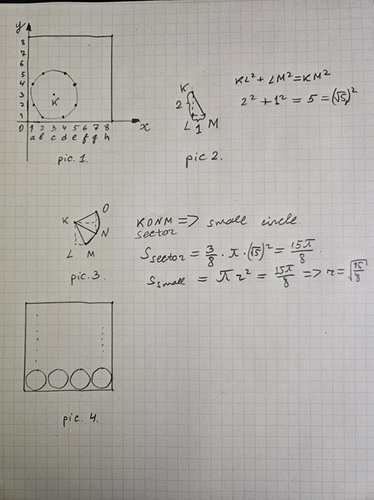
Knight's tour. Go around all the cells of the chessboard with a knight, having visited each cell only once.
I place the knight on the chessboard and show all possible knight's moves, as seen in pic. 1. A knight moves like the letter "L" from the english alphabet.
I start from the letter "L". I add 1 line to the letter "L" to connect the beginning and the ending of one knight's move. This action formed the right triangle $\triangle KLM$, as seen in pic. 2.
Apply Pythagorean theorem to
$KL^2+LM^2=KM^2, 2^2+1^2=5=(\sqrt5)^2\approx(2.2361)^2$
All 8 knight moves from point c3 or $K(3,3) \space or \space x_K=3, y_K=3$ in pic.1 are located at the same distance 2.2361 squares.
And this is definition of circle with the center in K $(x-x_K)^2 + (y-y_K)^2=R^2 \space or \space (x-x_K)^2 + (y-y_K)^2=5$
So all knight moves lie on a circle in integer coordinates with a radius of $\sqrt5(\approx2.2361)$
Now, let's take a look on the algorithm for knight's tour. Situations when a knight has less than 8 moves can be described with circles as well. Please, see the pic. 3.
The formula to calculate area of a circle is $S_{circle}=\pi*R^2$
A knight has 3 moves which make a sector of a circle $\overset{\frown}{MNOK}$
$S_{KONM}=\frac{3}{8}*S_{8moves}=S_{3moves}$
I am looking at the area of the 8 moves circle and the 3 moves segment.
$S_{8moves}=\pi*R^2=5*\pi, S_{3moves}= \pi*r^2=\frac{3}{8}*5*\pi \space =\gt r=\sqrt{\frac{15}{8}}\approx1.3693$
It is easy to understand that a chessboard is a big square and it can be filled with more smaller circles than with big circles.
Round up $1.3693=2$ and compare pic. 1 and pic. 4. The conclusion is for knight to move to a smaller circle or a square with a minimum number of possible moves.
I use JavaScript recursion to calculate all 64 knight's tours on a chessboard.
math.alex64.com uses the IP2Location LITE database for IP geolocation.